Beyond the Comfort Zone: Why Do We Take Risks?
When we compare this quest with the “safe” harbors of modern life, the picture becomes clear. Today, many people build sterile “bubbles” in high-security compounds, stripped of any risk. Yet inside this zero-risk lifestyle, the fear of missing out (FOMO) quietly grows.
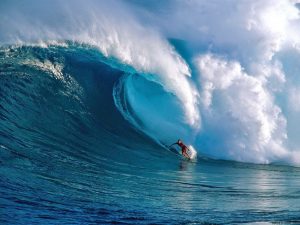
“You wouldn’t understand…” 🙂
Why the North Route and Why in Winter?
When I learned that Sönmez Erkaya intended to climb Mount Ağrı via the north route in winter, I said I would join without hesitation. The north route is a challenging path with dangerous crevasses. When I think about the classic route climb I did in the summer, the difference is as stark as black and white. Back then, horses carried our bags, and we were hosted in the famous chef-prepared camps of Nuh Ararat with, so to speak, “five-star hotel” comfort. I now understand much better the value of the logistical support provided by Mehmet Çeven Bey. Because this time the stage is completely different: No logistical support, no assistants. We will carry our 20-25 kilogram world on our backs from the base to the summit, pitch our tent ourselves in the middle of the glacier, and prepare our own meals in freezing cold.
In the literature, the period between December 21 and March 21 is referred to as “Winter Climbing.” The short days and merciless weather conditions turn this period into a matter of prestige for mountaineers.
Preparation in the City: From the Office Desk to the Mountain Base
It is impossible to jump straight from the sedentary modern office life to above 5000 meters. That’s why I started preparations two months in advance. To build conditioning, I did summit climbs in Uludağ and Aladağlar; I trained my muscles for technical climbing in Ballıkayalar and at climbing gyms.
A few days before the activity, I stopped exercising; because a minor sprain or a throbbing tooth in the city can turn into a nightmare multiplied by ten on the mountain. Especially after researching the pain in my kneecap, I acquired a quality knee brace. (You can read about the interesting coincidence I experienced with my colleague Hakan while looking for this knee brace at the sports store here).
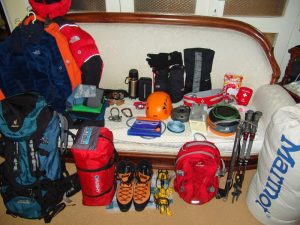
There is one day left until the Ağrı journey. Since I have the habit of having a feast before and after the activity, I meet with “mouth-watering” flavors at a nice restaurant. The big day is coming. Since plane tickets are cheaper, we plan to fly to Kars and then continue by road.
When we landed at Kars Airport, we met with Latif Abi, who would take us to Ağrı. When we opened the trunk of the taxi, we came across Latif Abi’s own photo; it turned out he was a candidate for muhtar in the March elections! Throughout the journey, we talked about his life in Sarıkamış, his children’s education struggles, and the region’s current issues. With Latif Abi’s warm and sincere conversation, we didn’t even notice how the three-hour drive passed.
The Adventure Begins in Doğubayazıt
When we arrived in Doğubayazıt, the sun had already set, and a gray evening had fallen over the city. We will spend the night at İsfahan Hotel, one of the symbols of the region and an indispensable stop for mountaineers. As we entered the lobby, we were greeted by the leading names of our team, Kürşat Öztürk and Ferhat Ulu. They had arrived two days earlier and successfully completed the winter summit of Little Mount Ağrı, which had finally reopened for climbing after being closed for many years due to security reasons. Although Little Ağrı seems to remain in the shadow of its majestic brother, with its 3896-meter altitude, it is actually a tough mountain that cannot be called “little” at all. We congratulated them on their success and listened eagerly to their fresh insights.
Lobby Meeting: Counting Grams
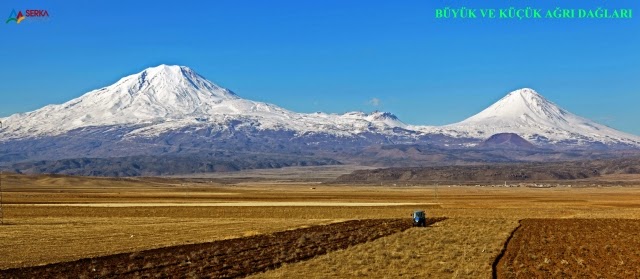
We are sitting in the lobby listening to Sönmez’s activity plan. The most critical part of the meeting was the statement made by Sönmez Hoca. As a result of official correspondence with the gendarmerie, we learned that permission was not granted for the north route we had dreamed of, due to security reasons. We had to head to the classic route. Although the question “Can’t we go without permission?” crossed our minds, we quickly dismissed the thought by remembering the fines given to those who climbed Cilo Dağı without permission and the responsible mountaineering ethics. There was no point in taking that risk.
When we checked the weather reports, we saw that the temperature would rise, but the real threat was the wind. Winds of 25 km/h and above could turn a winter climb into a survival struggle. The fact that only one team had been able to reach the summit this season was proof of how serious our opponent was.
Final Touch: Aspirin Duty
As the meeting was about to end, Kürşat asked if we had taken aspirin. We said we didn’t have any. He said that since blood tends to clot more at high altitude, aspirin would be beneficial to increase its fluidity. Hakan and I hit the streets of Doğubayazıt at night. When we found the on-duty pharmacy and got those small but important pills, all the missing pieces in our minds were complete. Now there was only us, our equipment, and Mount Ağrı with its enormous shadow.
Day 1: 3200 Meters – The First Test of Willpower
The next morning we woke up early and refreshed. At breakfast, the soft, creamy Iranian cheese I tried for the first time left a pleasant impression on my palate. Just as everything was ready and we were about to head to Eli Village, we noticed something missing: Tarık Abi. When we went up to his room, we found him resting; it turned out he had thought the departure time was one hour later. After overcoming this small delay, we piled into the minibus and began our journey toward the foothills of Ağrı.
10:00 AM
In the first minutes of the hike, everything was fine. Our stomachs were full, we had slept well; Initially, we felt as light as pigeons, but as the incline steepened, my backpack began to feel like a “30-kilogram wet wool blanket”—the kind you’d find at a grandmother’s house. The pressure was so intense I could barely move my head.
I was starting to fall behind. Tarık Abi was also accompanying me with the pain in his knee. When the fog descended and light snow began to fall, I started humming the folk song that came to my tongue to keep my morale high: “Bir kar yağar ince ince…”
4:00 PM – Tent Setup Struggle and Rising Tension
When we reached the main camp at 3200 meters with my tent mates, we were on the verge of exhaustion. But it was still too early to rest; first we had to set up the shelter where we would survive—the tent. We have snow stakes to secure the tent, but due to the strong wind, we still need to anchor it with stones. Finding stones buried in the ice and prying them out with an ice axe turned into pure torture. My tent’s 1.35-meter height normally provides comfort, but in this storm, it became a disadvantage against the wind.
While Hakan, Halit, and I struggled with the tent, the intense stress caused by fatigue surfaced. When we saw that our efforts were not enough due to the wind, I asked for help from Ferhat, who had just finished setting up their tent nearby. The intense emotional state from fatigue must have affected Hakan quite a bit, because during the tent setup, he had a short, unnecessary argument with Ferhat. This brief, pointless dispute was the first sign of tension at high altitude. Fortunately, with Ferhat’s help, we secured the tent, and when everyone retreated to their corners, the atmosphere calmed down again.
Adrenaline in the Kitchen: Dancing with Flames
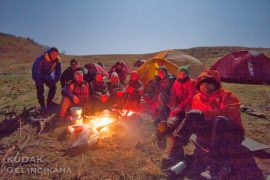
In the freezing cold, our only desire was to drink something hot. We set up the stove in the “vestibule” part of the tent and filled the pot with snow. At that moment, we also took Tarık Abi, who had just reached the camp, into our large tent on Sönmez Hoca’s suggestion; now there were four of us inside. After drinking our tea bags and recovering a bit, the real adventure began. I take out the large pot from my bag to prepare soup. I fill it with snow and put it on the stove. We take turns coming to the stove from time to time to check if the water is boiling.
While Halit was checking if the water was boiling, suddenly flames rose from the top of the stove cylinder. We had to decide in seconds in the face of flames reaching one meter. Without panicking, we throw the snow we scooped into our palms onto the stove. The flames on the cylinder went out, but since the stove was still burning and the gas leak continued, the cylinder flared up again. With a second snow intervention, we finally managed to extinguish it completely. I guess we had loosened the head while checking the cylinder and caused a gas leak.
That momentary fear we experienced put us, in the literature’s term, into a full “yusuf yusuf” situation 🙂 We didn’t dare to light the stove again. We made do with dry foods for dinner and took refuge early in our sleeping bags, heading toward the uncertainty of the next day.
Day 2: 4200 Meters – One Step Closer to the Sky
Morning 08:00 – The Rhythm of the Camp
We started the day with light music coming from one of the neighboring tents. Mornings on the mountain are quiet but hectic moments when everyone prepares their breakfast in their own inner world and slowly gets ready. I left the stove, cylinder, and a few dirty clothes that had given us those terrifying moments last night at the 3200 camp to pick up on the way back. Now it was time to account for every gram. We would continue our journey with Halit’s stove.
Our goal was the last stop before the summit: the 4200-meter camp.
Altitude and Human: The Aspirin and Water Issue
Before heading out, I popped an aspirin and swallowed it dry to counteract the blood thickening caused by the high altitude. Hakan followed suit but then asked me for water. ‘Just swallow it,’ I snapped. That brief exchange was actually a reflection of the split-second irritability brought on by sheer exhaustion. Although Hakan was annoyed, thinking I was begrudging him a cup of water, my mind was echoing the ‘Buy water’ warning I had repeated dozens of times during our supplies run. A plastic water bottle from the market wasn’t just for hydration; it was a vital piece of logistics for handling ‘the call of nature’ during freezing nighttime storms without sacrificing the comfort of the tent (yes, that bottle gets the job done inside).
The Altitude Paradox: Why Do We Get Out of Breath?
Interestingly, even though the load in my backpack had decreased, it felt like it was getting heavier with every step. Even a small step was enough to leave me breathless. It is generally said that “there is less oxygen up there,” but the truth is a bit different:
At high altitudes, the air isn’t “missing” oxygen; rather, the atmospheric pressure is lower, meaning oxygen molecules are more dispersed. To compensate, your heart and lungs work twice as hard. Even a small step leaves you breathless. We reached our final camp before the summit at 16:00. The weather seemed stable, but we knew the real challenge would begin at midnight.
4:00 PM – Final Camp
Right on time, around 4:00 PM, we reached 4200 meters. Luckily, the weather was friendlier than yesterday. Without struggling with the wind, we set up our tent and took shelter inside. We needed to gather energy for the summit night. We quickly ate something and buried ourselves in our sleeping bags for the big appointment that would start at midnight.
Summit Day: Willpower, Ice, and Hell Creek
01:00 AM – Space Shuttle and Warm Sleeping Bags
I woke up to the sound of the alarm in the darkness. The intense humidity inside the tent had covered our sleeping bags like a soaking wet blanket. I called out to my friends, but there was deep silence. While I was having my own breakfast, they woke up one by one; but the mountain started to take its first casualties here. Halit said he couldn’t continue due to severe pain in his legs, and Tarık Abi due to his knee. I’m not trying to encourage anyone to come. Because my own condition wasn’t great either; if they let me, I could sleep for two days right where I was. But that invisible engine inside me had already started running.
Hakan borrowed Halit’s more technical boots and gloves. We quickly had breakfast and rushed outside. The summit journey is similar to the launch moment of a space shuttle. The hardest phase is the first moment you break away from “gravity,” that is, from that comfortable sleeping bag. The faster you escape from the Earth’s gravitational field—that is, the faster you leave the warm sleeping bag—the better. After that, it’s time to leave the fuel tanks (fatigue) behind and move forward with small thrusts to enter orbit.
Mehter March in the Darkness
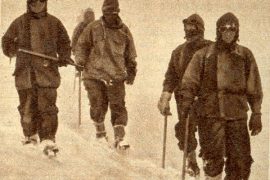
Why do we climb at night? Because on the mountain, you need to reach the summit and descend before the weather deteriorates in the afternoon. Also, at night, the snow stabilized in low temperatures reduces the avalanche risk somewhat. When we set off, our pace resembled a Mehter march: Take two steps, stop, catch your breath, and lift your head to check front and back… Even though Hakan’s conditioning was much better, he stayed right behind me, adapting to this pace.
French Technique (Pied à Plat): Duck walking up to 45 degrees, and on steeper sections, the elegant “curtsy” steps where the feet cross. The main goal is to get all the crampon points in contact with the ground.
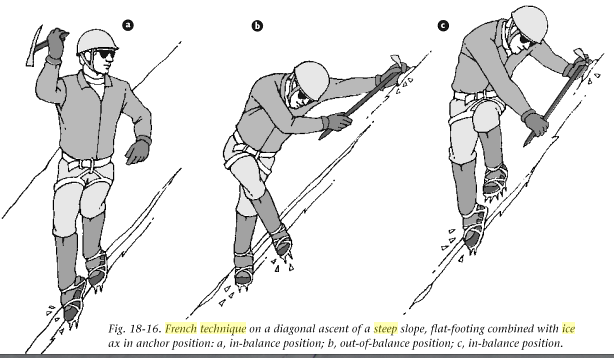
In winter climbing, the hardness of the snow determines your fate. Hard snow turns the tracks opened by the person in front into staircase steps. In soft snow, slipping back with every step drains your energy like a black hole.
The Real Face of Cold: Aydın Abi’s Farewell
As the day dawned, the freezing cold was piercing our bones. Behind Hakan’s repeated “I’m cold” comments actually lay the desire to “turn back”; I would understand this much later. I said maybe we can warm up a bit when the sun rises. When I was moving, the heat my body produced was enough for me. But during short stops, I too was suffering from the cold.
Right at that moment, we met Aydın Abi coming down from above. Despite being one of the most resilient in the group, he couldn’t warm his fingers due to a small deformation in his glove. When he showed the loss of sensation in his fingers, we understood the seriousness of the situation. “Frostbite” cannot be ignored; Aydın Abi did the rational thing just short of the summit and turned back. We later learned that the darkening in his finger was the harbinger of a treatment that would last for weeks.
This situation reminded us of mountaineering’s unbreakable golden rule: Mountaineering is a three-legged stool consisting of mental preparation, physical strength, and perfect equipment. If one leg breaks, the summit becomes a dream.
10:30 AM – Cehennem Deresi (Hell Creek): Between Ice and Sorrow
As we ascended toward the summit, we reached the mountain’s most critical and psychologically heaviest point: Hell Creek. This is not just a physical obstacle but also a deep wound in our mountaineering history. It was right here in 2000 that we lost İskender Iğdır, a writer for Atlas Magazine who was part of the team led by Nasuh Mahruki, in an unfortunate accident.
In front of us lies a sharp 20-25 meter traverse that requires maximum attention and technical gear. At this altitude, seasons have no say; the ground is covered with a deep blue ice mass throughout the four seasons. If there is little fresh snow, this place turns into what we call “glass ice”—a smooth and deadly glacier.
This section, which is impossible to pass without crampons, does not tolerate mistakes. Even if your crampon points grip the ice, the slightest loss of balance can send you accelerating toward a hundreds-of-meters drop. In such a moment, your only salvation is to drive your ice axe into the ice within milliseconds and try to stop yourself. Listening to the high-pitched, metallic sound our crampons made on the glass ice, we leave the throat of Hell Creek behind with great concentration.
Now we are in the last 150 meters. Although the slope gets a bit steeper, the scent of the summit makes us forget our fatigue. Our excitement begins to beat in our hearts like an arrhythmia as we approach the highest point of the sky.
11:00 AM – Summit: Five Minutes Above the Clouds
My body is starting to rebel. The relentless nausea in my stomach and the rising urge to vomit are clear signs of high altitude (AMS – Acute Mountain Sickness). We gained altitude very quickly in a very short time; my body is struggling to “acclimatize” to this new world. Normally, these symptoms are the mountain’s way of saying “Go down!” However, we are so close to the summit plateau that my mind manages to silence my body’s cries for a short while. Assessing that my condition is not yet critical, I continue on my way, carefully watching every step.
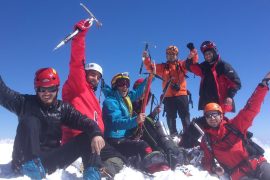
When we stepped onto the summit plateau, we encountered a nice surprise: Mehmet Yaldız, Mehmet Güngör, and Esin Handal were there! Honoring the saying “A pilgrim finds another pilgrim in Mecca, a mountaineer finds another on the summit,” we greet each other briefly in the middle of the freezing wind. And the last few steps… As of
11:00 AM, we are at 5137 meters, on the roof of Turkey.
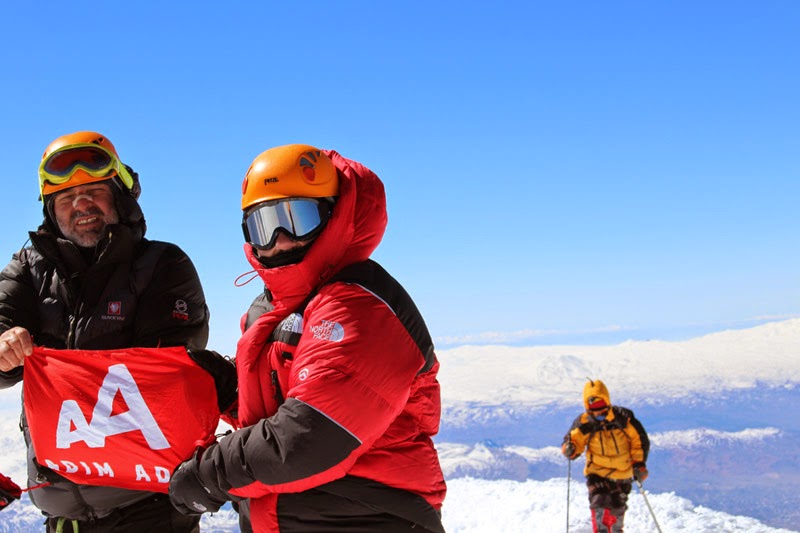
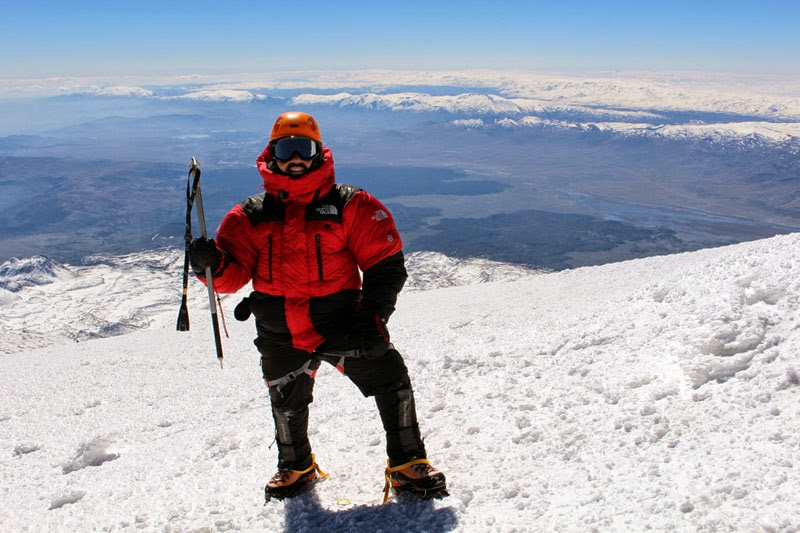
Things to pay attention to when having a summit photo taken:
At the summit, oxygen is so scarce that your brain focuses solely on survival; aesthetic concerns simply fly out the window. If you don’t want to descend and think, “What on earth was I doing there?”, engrave these few points into your mind (you can look at my photos as a cautionary tale 🙂):
- For the love of mountaineering, don’t hold your ice axe like a total amateur 🙂 Put the leash on your wrist properly. Position the pick so it’s facing sideways (the technical stance). It’s better to actually look like a climber in the photo.
- When pulling your phone out of your jacket pocket, the lining might have popped out—check yourself, brother!
- Fix your helmet, and take off your goggles for a brief moment so people can actually tell who you are. Otherwise, looking like “Donatello from Teenage Mutant Ninja Turtles” in your photos is inevitable!
- Keep your snot in check! Yes, it’s gross but true; in that freezing wind, you might not even realize your nose is running. Give it a quick check or a wipe before the shot. Otherwise, in that epic summit frame you’ll keep forever, the “icicle” hanging from your nose will grab more attention than your charisma. A glorious mountaineer or a melting snowman? You decide!
Final word: I’ve made these mistakes, so you don’t have to… 🙂
Escape from the Storm: 21-Hour Marathon
The excitement of the summit was short-lived; when I descended to the 4200 camp, the scene I encountered was shocking. The storm had pulled out the stakes of my tent, and our home was almost about to fly away, half hanging in the air. Normally we planned to rest one more night, but we learned that a storm reaching 80-100 km/h was on its way. With a quick decision, we packed up the camp and started the descent.
Most of the team was rapidly losing altitude by sliding “butt-first” on the snow. I, however, had to descend walking because I couldn’t balance with the huge load on my back. I’m coming down walking and falling behind. Tarık Abi is also falling behind due to his knee pain. Aydın Abi is going ahead because he is fit. He will stop by the 3200 camp and pick up the gear we left there and continue. To not keep the fast group ahead waiting and not be too late, we hurry as much as we can. Therefore, thinking that Aydın Abi would pick up my gear too, we pass without stopping at the camp. He also thought I would stop at the camp and pick up my gear. Due to this lack of communication, I ended up leaving my shining stove and a couple of small items there. Oh well, health comes first. Meanwhile, Aydın Abi, who went ahead, got lost in the darkness and reached another village instead of Eli village. Later, he rented a car and came to Eli village.
We are proceeding with Sönmez Hoca’s GPS device. Since there is no moonlight, our headlamps illuminate our way in pitch darkness. We know the direction we are going, but since we are in the open terrain, the place we are going is not a flat area, and there is no path. On our way, a valley with a depth of 20-30 meters appears in front of us. We descend into the valley with our backpacks and pass the valley by rock climbing. When we reached Eli Village, it was showing 11:00 PM. This huge activity that started at 2:00 AM and lasted exactly 21 hours had brought our bodies to the brink of collapse.
My feet, without any rest for 21 hours inside those heavy boots, had become “wrecked.” There was blood pooling in the big toe of my right foot (Later I went to the doctor and had the blood drained with a needle, but within 2 weeks my nail turned black and fell off. Fortunately, a new nail grew in 8 months and it returned to its old state). We jump into the minibus that was waiting for us as previously arranged and head toward the center of Doğubayazıt district. When we arrive at the district center, I leave my gear at the hotel and go out to get something to drink. At that hour, only a liquor store is open… The old man inside is surprised when he sees my very tired state in mountaineering clothes. I was burning with thirst; I was craving a salty yogurt drink like crazy. I ask if there is yogurt drink. He is a bit surprised. I guess he is trying to understand if I am joking. I really need our national drink. It is the only thing that will quench my thirst. There is no yogurt drink. I bought water. How burned my insides were… I quench my thirst. I returned to the hotel, this time lay down on a soft bed instead of my sleeping bag, and fell into the most peaceful sleep in the world.
The next day, after breakfast, we go out for a city tour. We visit İshakpaşa Palace. In its courtyard, I capture a nice frame that I liked. You can find more photos about İshakpaşa Palace in my Eastern Trip article.
The return journey is again with Latif Abi’s taxi from Doğubayazıt to Kars.
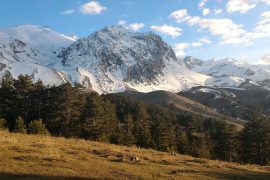
There is a sweet fatigue on everyone. I look out the window. We have been on the road for about an hour, but Mount Ağrı is still standing in front of us in all its majesty and is not getting smaller at all. In my ears, the music of the Mount Ağrı Legend is playing. I have collected many memories, and the memories are passing before my eyes. I feel like a small satellite orbiting the mountain, unable to escape its pull.